

Porcelain benchtops in Melbourne have become a popular choice in modern kitchens and bathrooms. Homeowners love their sleek appearance, slim profiles, and design flexibility. Designers often specify them for contemporary spaces where a clean finish matters.
How Porcelain Benchtops Perform in Real Homes
Many homeowners expect porcelain to perform like natural stone. In reality, porcelain behaves very differently once installed. The most common issues appear along edges, cut-outs, and unsupported spans.
Key performance considerations include:
- Edge detailing around sinks and cooktops
- Structural behaviour around cut-outs
- Stress management in high-use areas
- Bonding and reinforcement considerations
These performance characteristics often become more noticeable over time, which is why understanding them early helps achieve the best results. Understanding why they happen is the first step toward avoiding them.
What Impacts Porcelain Benchtop Performance
Porcelain benchtop performance depends on understanding how the material differs from natural stone. Porcelain slabs are thinner, denser, and less forgiving when preparation and planning are not fully aligned with the material requirements.
Common causes include:
- Proper substrate preparation
- Suitable adhesive systems
- Careful slab handling
- Allowance for natural movement
Porcelain requires precise planning from the cabinetry stage through to final installation. Without that control, stress builds up inside the slab and eventually releases as cracks or chips.
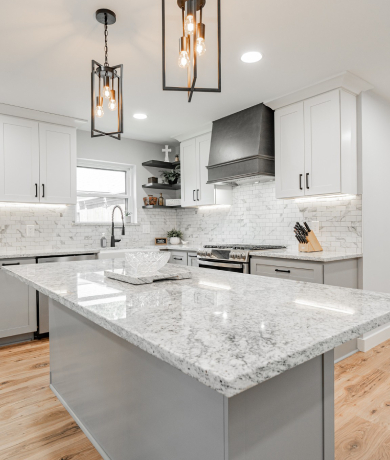
Understanding Porcelain Benchtop Fabrication
Porcelain benchtop fabrication demands specialised equipment and experience. Fabricators must reinforce slabs, manage vibration during cutting, and plan joins carefully.
Unlike stone, porcelain requires precise planning before cutting. Fabricators must get measurements right the first time. This level of precision separates experienced porcelain specialists from general stone suppliers. Proper fabrication supports long-term performance and structural reliability and improves structural performance.

The Porcelain Slab Cutting Process Explained
The porcelain slab cutting process plays a major role in maintaining edge quality and long-term performance. Porcelain is extremely dense and requires controlled techniques to achieve clean, accurate results. Precision at this stage supports both appearance and durability once installed.
Key elements of the cutting process include:
- Water-cooled cutting systems
- Help manage heat and maintain smooth, consistent edges
- Specialised diamond tooling
- Ensures clean cuts without stressing the slab
- Precision-guided measurements
- Allow accurate cut-outs for sinks, cooktops, and fixtures
- Controlled handling during cutting
- Maintains structural integrity across the slab
- Detailed edge finishing
- Supports a refined look and consistent surface quality
When handled with the right process and equipment, porcelain slabs achieve the clean lines and durability they are known for in modern kitchens and bathrooms.
Pros and Important Considerations for Porcelain Benchtops in Real Homes
Porcelain offers impressive benefits when installed correctly and understanding the technical performance behind the material helps homeowners make smarter decisions.
Pros
Heat Resistant
- Porcelain can withstand extreme heat without warping or cracking.
- Is fired at over 1,200°C during manufacturing
- Can tolerate direct heat from hot pots and pans
In controlled tests, remained unaffected under blowtorch exposure
Stain Resistant
Porcelain resists stains from food, wine, oils, and household chemicals.
- Water absorption rate below 0.5%
- More resistant to staining than marble or granite
- Non-porous surface prevents deep penetration
Scratch Resistant
Porcelain performs well in high-use kitchens.
- Scores 6–7 on the Mohs hardness scale
- Comparable to granite
- Harder than marble
Durable
- When properly supported, porcelain is engineered for strength.
- Withstood up to 2.5 times more impact force than marble in testing
- Performs similarly to granite under load
UV Resistant
Porcelain maintains colour consistency over time.
- Does not fade in direct sunlight
- Suitable for outdoor kitchens and alfresco areas
- More UV stable than quartz surfaces
Low Maintenance
Porcelain does not require sealing or polishing.
- Non-porous surface eliminates the need for sealing
- Simple cleaning with mild soap and water
- Lower long-term maintenance costs
Design Versatility
Modern manufacturing allows porcelain to replicate natural materials with precision.
- Mimics marble, concrete, timber, and stone
- Available in ultra-thin profiles
- Consistent patterns across slabs
Important Considerations for Porcelain Benchtops
To achieve the best results, porcelain benefits from careful planning and precise execution.
- Performs best with accurate cabinetry preparation
- Requires specialised fabrication techniques
- Benefits from proper support across spans
- Achieves optimal results with experienced handling
Planning a porcelain benchtop project?

When Porcelain Is the Right Choice
Porcelain is best suited for applications where design precision and heat resistance matter. It performs well on straight runs, splashbacks, and low-impact surfaces, making it a strong choice for modern kitchens.
Porcelain performs best in:
- Straight, well-supported benchtop runs
- Clean splashback and wall panel applications
- Low-impact surface areas with consistent use
- Spaces with accurate and level cabinetry preparation
Matching porcelain to the right application ensures a refined finish, long-term durability, and consistent performance in everyday use.
Why Well-Planned Porcelain Projects Perform So Well
Melbourne homes vary widely, from inner-city apartments to large suburban builds. Well-planned porcelain projects consistently deliver strong results when every stage is aligned from the beginning.
Strong outcomes are supported when teams:
- Prepare cabinetry with precision
- Reinforce high-use and detailed areas
- Maintain consistency throughout fabrication
At Stonaa, porcelain benchtops are approached as a technical surface rather than just a decorative finish. This ensures each project delivers durability, consistency, and a refined final result.
Final Thoughts and Expert Guidance
Porcelain benchtops offer outstanding performance when planned and installed with precision. While the upfront cost can be higher than some alternatives, the long-term value often makes it a worthwhile investment. Their durability, heat resistance, and low maintenance requirements support consistent performance over time.
The best results come from understanding how porcelain is fabricated, prepared, and integrated into the overall design. When these elements are considered from the beginning, porcelain delivers both visual refinement and long-term reliability.
For homeowners and designers seeking clarity before committing to porcelain, Stonaa provides expert guidance backed by real-world fabrication and installation experience across Melbourne.
Thinking about porcelain benchtops for your home?
Frequently Asked Questions
Are porcelain benchtops fragile?
Do porcelain benchtops need special installation?
Is porcelain harder than stone?
On the Mohs hardness scale, porcelain typically scores between 6 and 7, making it comparable to granite and harder than marble. However, hardness does not equal structural strength. Natural stone slabs are often thicker and may tolerate minor structural movement better than ultra-thin porcelain.
