
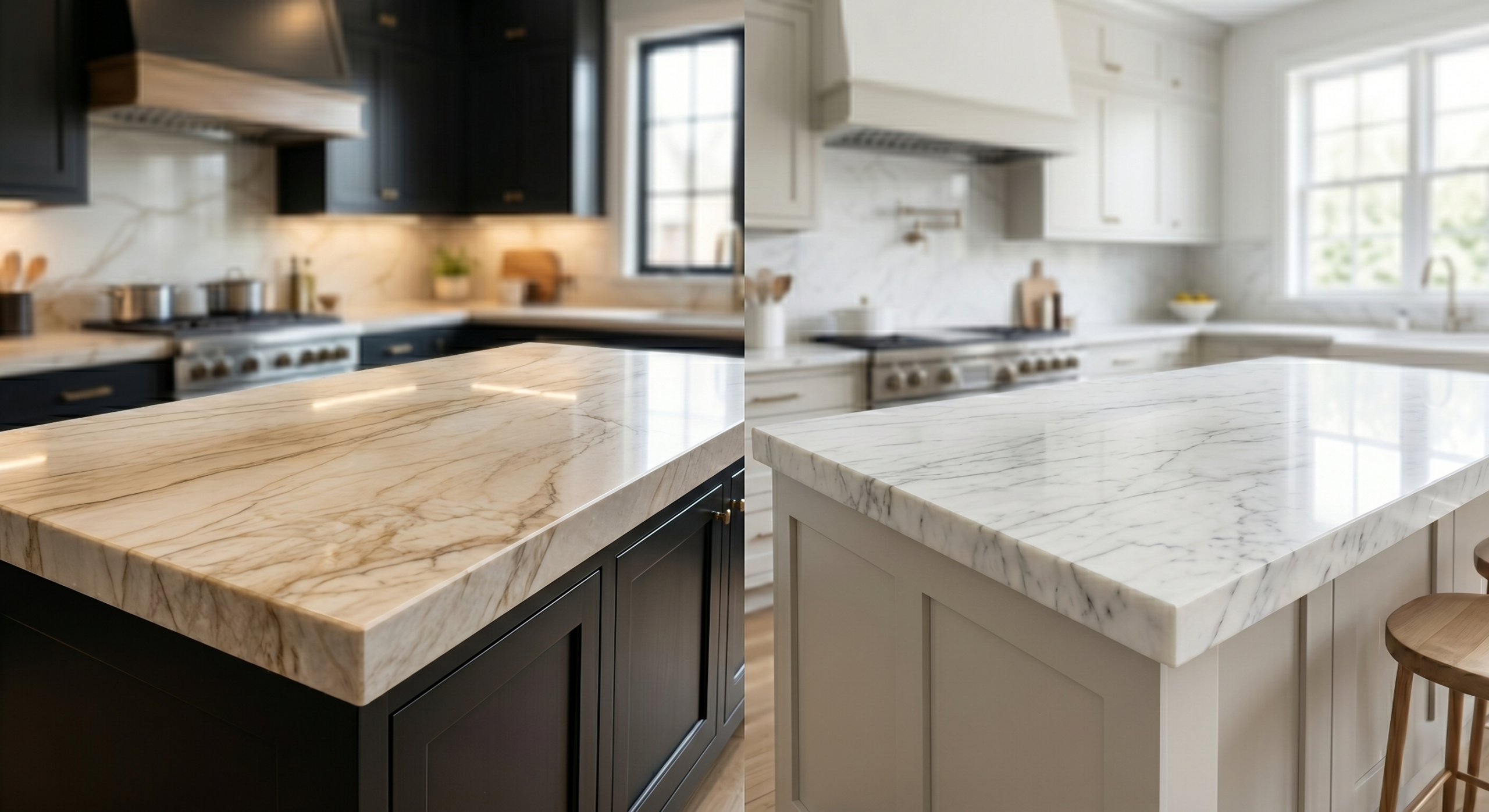
Kitchen renovation is one of the most profitable industries in Australia. The benchtop sector alone reached 4.85 million square metres in 2025 and is projected to gain approximately 5.3% year-on-year until at least 2034. There exists one reason in particular for why that growth is accelerating. Australia became the first country in the world to ban engineered stone containing more than one per cent crystalline silica when Safe Work Australia did so in July 2024. It was introduced after a silicosis crisis among stonemasons who had spent years cutting and handling the material.
The practical result?
Hundreds of thousands of Melbourne homeowners planning a kitchen renovation can no longer default to engineered quartz. Natural stone is now the primary choice. And two names keep coming up in that conversation: quartzite and marble.
Both are stunning. Both are premium. Pick the wrong one for your kitchen and lifestyle and you will know about it within a year. This guide gives you the honest side-by-side so you can get the decision right the first time.
Quick Answer: Which Stone Is Better for Melbourne Kitchens
Quartzite is good for active homes that want the durability of natural stone, enhanced heat resistance and less everyday maintenance. Marble is for those who prefer a classic luxury look, softer visual flow and are willing to put in some extra attention for maintenance. Both are premium materials.
The right choice really depends upon how your kitchen is utilised.
- Best for durability: Quartzite
- Best for luxury appearance: Marble
- Best for lower maintenance: Quartzite
- Best for timeless design appeal: Marble
- Best for premium Melbourne resale value: Both, when professionally installed
Understanding Marble and Quartzite Before You Choose
In a showroom, the visual similarities between quartzite slabs and marble can be striking, making them frequent subjects of comparison. While the two might appear nearly identical under LED lights, several years of use in a Melbourne kitchen will reveal significant differences.
What Is Marble
Marble is produced from limestone when it goes through metamorphosis over millions of years under high pressure and temperature. This process creates the fine veining, smooth finish and classic cold depth that marble is loved for all over the globe.
It is a softer natural stone. In fact, that softness is what gives it all of its visual richness. Some popular types in Melbourne kitchens are Calacatta, Carrara, Arabescato and Statuario. They each have their own movement, their warmth that no synthetic surface could ever replicate.
What Is Quartzite
Sandstone becomes quartzite under high geological pressure. This process crystallises the quartz grains into a tightly packed, interlocking pattern that measures 7 to 7.5 on the Mohs scale of hardness – harder than most granites, and far tougher than marble.
Some varieties of quartzite do deliver the soft warmth that many homeowners love about marble. Taj Mahal, Mont Blanc and Sea Pearl are the most specified options for Melbourne kitchen benchtops at the moment. They have a marbly look while having a much better and stronger day-to-day performance.

Appearance and Design Style
Both stones create beautiful kitchens. They just do it differently and suit different design directions.
Marble is characterised by stronger, longer veins, giving a feeling of visual softness and a refinement combined with light-reflecting polish. It leaves a polished, traditional look that is also perfect for kitchens aiming to achieve classic style and architectural relevance. Calacatta and Statuario have drama and depth difficult to match in natural stone kitchen benchtops.
Quartzite, on the other hand, looks more organic, with less movement. It complements timber cabinetry and brushed brass hardware beautifully – marrying well with the organic palettes of high-end kitchen renovations in Brighton, Toorak, Hawthorn and Kew right now.
One point most homeowners overlook is slab variation. Every natural stone slab is unique. This is especially true of quartzite. A small sample in a showroom rarely captures the full movement, warmth, or veining of a complete slab. Always view the actual slab that will be fabricated for your kitchen before committing. Not a photo. The slab itself.
Durability in Everyday Kitchens
This is where marble vs quartzite diverges most clearly. It is also where honest conversation needs to happen.
| Feature | Marble | Quartzite |
|---|---|---|
| Hardness (Mohs) | 3 to 4 | 7 to 7.5 |
| Scratch Resistance | Moderate | High |
| Heat Resistance | Moderate | High |
| Etching Resistance | Lower | Higher |
| Sealing Frequency | Every 6 to 12 months | Annually |
| Surface Movement | Soft and dramatic | Natural and textured |
| Best Use | Design-focused kitchens | Busy family kitchens |
Marble reacts to acidic ingredients. All of them cause etching – dull marks on the surface that no amount of scrubbing can get rid of – with lemon juice, vinegar, wine and tomato-based sauces being particularly troublesome as these substances remain in contact with your countertop. This can only be fixed through professional honing. That’s a trade-off that deserves some serious consideration in a Melbourne kitchen where you cook from scratch almost every day.
Quartzite handles these conditions far more comfortably. Its denser composition resists the acidic reactions that marble struggles with. In busy Melbourne family kitchens, quartzite consistently becomes the preferred benchtop material once homeowners understand how it actually performs.
Both stones are durable when fabricated and installed correctly. The real difference is how forgiving each one is when ingredients get spilled, surfaces get scratched or hot cookware makes contact.
Need Help Comparing Marble and Quartzite Benchtops?
Maintenance and Long-Term Care
Neither material is maintenance-free. Both require regular sealing and sensible kitchen habits. But the commitment level differs, and being honest about your household before choosing will save real frustration later.
Marble kitchen benchtops benefit from:
- Sealing every 6 to 12 months
- Immediate cleaning of acidic or pigmented kitchen spills
- pH-neutral cleaning products only
- More mindful day-to-day care in an active cooking environment
Over time, marble develops a softer, lived-in appearance known as a patina. Many homeowners appreciate this. Others find it difficult to accept on a surface they use every single day. That is a personal call worth making before you commit.
Quartzite kitchen benchtops are more forgiving and typically require:
- Annual sealing with a quality penetrating sealer
- Basic pH-neutral cleaning after cooking and food prep
- Less concern around accidental kitchen spills
- Lower overall long-term maintenance involvement
Both stones benefit from trivets near hot cookware and cooktops. Quartzite handles occasional heat contact with considerably less risk than marble.
Cost, Value and Long-Term Investment
Both marble benchtops Melbourne and quartzite benchtops Melbourne sit firmly in the premium category for kitchen renovation materials. Treat them as long-term investments, not renovation line items.
Marble kitchen benchtop pricing in Melbourne generally runs between $450 and $1,500 per square metre, supply and installation included. Where you land in that range depends on origin, slab rarity, veining quality, thickness, and finish. Rare Italian varieties like Calacatta Oro sit firmly at the upper end.
Quartzite starts at a similar level and can reach $1,800 to $2,200 per square metre for premium Brazilian varieties. Harder fabrication requirements, longer cutting times, and more demanding installation processes all contribute to that cost.
From a resale perspective, both add measurable value in Melbourne’s premium property market. Kitchens in South Yarra, Brighton, Toorak and Kew consistently attract buyers who recognise natural stone kitchen benchtops as a quality signal. A professionally installed natural stone benchtop almost always supports strong long-term resale appeal.
Common Mistakes Melbourne Homeowners Make
Most stone guides skip this section. It is one of the most useful things an experienced kitchen benchtop fabricator can offer, so here it is.
Choosing from small samples only
- Natural stone varies dramatically across a full slab. A small sample rarely shows the full movement, veining depth, or warmth at benchtop scale. What looks pale and quiet in a sample can be bold and dramatic across a full kitchen run.
Ignoring maintenance expectations
- Many homeowners choose marble for its appearance without fully considering the etching risk in a real cooking environment. Marble is an excellent kitchen benchtop material. It suits homeowners who are prepared to maintain it properly. Going in without that understanding leads to disappointment.
Prioritising trends over kitchen use
- A beautiful kitchen still needs to function for the people using it every day. Households with heavy cooking and young children often benefit more from a benchtop that aligns with how the kitchen is actually lived in.
Skipping the slab inspection
- Viewing full slabs under natural light gives a far clearer picture of how the benchtop will look in your kitchen than any photograph or small showroom sample can provide.
Choosing fabricators without kitchen benchtop experience
- Edge detailing, slab matching, joinery precision and installation quality all influence how the stone performs and looks across the full kitchen benchtop. This decision matters as much as the stone itself.
Which Stone Suits Your Kitchen Best
Marble may suit your kitchen if you:
- Prioritise timeless luxury and softer visual movement across the benchtop
- Want a statement kitchen surface with classic appeal and dramatic veining
- Appreciate natural ageing and patina as part of owning a natural stone benchtop
- Are designing a refined, architecturally considered Melbourne kitchen
- Cook infrequently or are comfortable managing spills and maintenance consistently
Quartzite may suit your kitchen if you:
- Cook frequently and want a kitchen benchtop built for real daily use
- Want stronger heat and scratch resistance in an active cooking environment
- Prefer lower-maintenance natural stone without compromising on appearance
- Have a busy household where the kitchen benchtop needs to perform under pressure
- Want the warmth and movement of marble with significantly better durability
Still unsure? Come on site and handle both slabs in person under natural light. This single step resolves the decision for most Melbourne homeowners within minutes.

Why Melbourne Homeowners Choose Stonaa
At Stonaa, we have been fabricating and installing premium natural stone kitchen benchtops across Melbourne for over 20 years. Every project runs through our Dandenong South workshop, where our own team manages templating, CNC cutting, edge profiling, fabrication and installation from start to finish. No subcontractors. No shortcuts.
We work with both marble and quartzite kitchen benchtops because different homes and kitchens require different solutions. Recommendations are based on how our clients actually cook and use their kitchens, not on what is simplest to supply.
Explore our quartzite benchtops Melbourne and marble benchtops Melbourne ranges to see what is currently available. Visit our showroom and let our team walk you through the full slab selection in person.
Final Thoughts
The decision between quartzite vs marble for your kitchen is not about choosing a universally better stone. It is about selecting the material that suits how your kitchen is used, how it is designed and how much ongoing care you are genuinely prepared to invest.
Marble delivers timeless elegance and natural softness that few kitchen materials can replicate. Quartzite offers natural beauty with stronger durability for busy kitchens and active family cooking. Both are exceptional choices when selected carefully and installed by the right stonemasons.
