
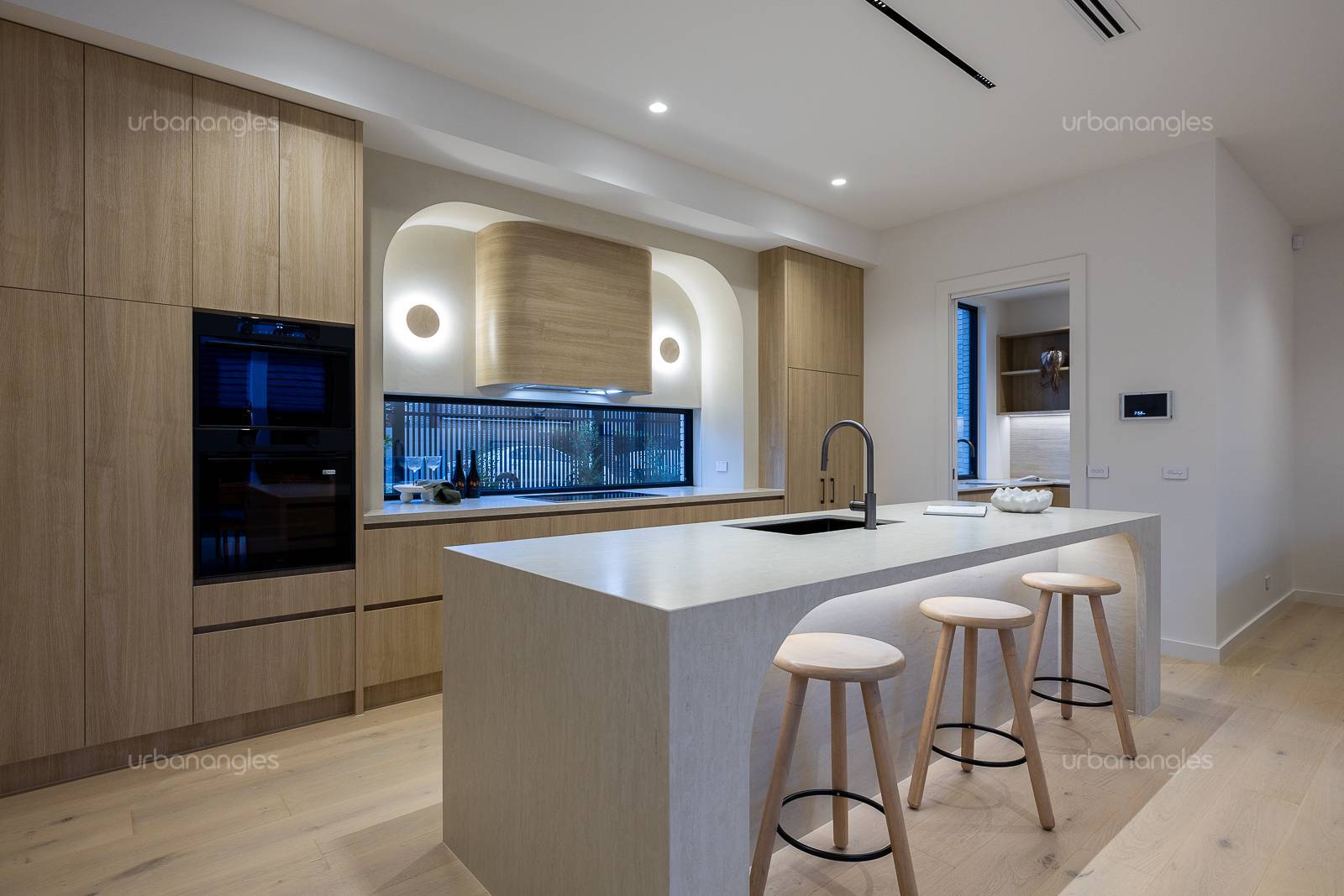
The Colosseum was built with travertine stone slabs. So were the Roman baths and countless Mediterranean structures still standing today. Its presence in Melbourne kitchens and bathrooms is not a trend catching on – it is a material returning to the spaces it has always suited.
Travertine forms when calcium-rich mineral water rises through the earth and evaporates, leaving calcium carbonate deposits that accumulate in layers over thousands of years. The result is a sedimentary stone with natural voids, warm tonal variation and a surface quality that engineered materials have been attempting to replicate for decades.
Key Travertine Properties Homeowners Should Know
| Property | Detail |
|---|---|
| Stone Type | Sedimentary limestone |
| Hardness (Mohs) | 3 to 4 |
| Porosity | Moderate to high, sealing required |
| Thermal Performance | Stays cool underfoot, suits Australian outdoor climates |
| Finish Options | Honed, polished, brushed, tumbled, filled, unfilled |
| Indoor Suitability | Tiles, benchtops, bathrooms, feature walls |
| Outdoor Suitability | Pavers, pool surrounds, alfresco areas |
| Maintenance Level | Annual sealing, pH-neutral cleaning |
What Is Travertine Stone and Why Is It Different
Walk into a room with travertine – and you notice it. The tone, the slight irregularity, the fact that no installer can make two slabs look identical – even if they try. Most people clock those qualities without thinking much about what actually causes them.
It comes down to the cellular structure. Travertine develops small natural voids throughout its body during formation. Those voids create depth and cast a shadow in a way that uniform surfaces cannot fake. Light reads differently across the stone at eight in the morning versus four in the afternoon. Cut two slabs from the same quarry block – and they still will not match. That is not an inconsistency. That is just what the material is.
Marble and travertine both come from the limestone family, but end up very different in use. Marble goes through intense metamorphic pressure – comes out harder, denser and more polished in nature. Travertine skips that process entirely. Softer, more textured, more alive in character. Designers who spec it regularly tend to say the same thing: it gets better the longer it sits in a space.
Why Travertine Still Works in Australian Homes
Five or six years ago, Melbourne renovation briefs started changing. Not dramatically – gradually. The requests for clinical white surfaces and mirror-polished finishes slowed down. Clients started describing what they wanted differently. Grounded. Considered. Less concerned with looking perfect. Brighton, Hawthorn, and Toorak showed it first. Most of the city followed.
Travertine lands well in that context. Ivory, beige, and silver tones alongside timber cabinetry and brushed brass hardware – it works in a way porcelain and engineered stone keep trying to replicate without quite getting there. There is also the indoor-outdoor question. Australian homes are increasingly built around the connection between living areas and covered alfresco spaces, and travertine reads as belonging in both without any effort.
How it ages is the part that does not get enough attention. Engineered surfaces are uniform by design – every scratch and mark sits against a perfect background and announces itself. Travertine builds character instead. Year ten looks more interesting than installation day, not less. A number of the architects and designers we work with say this is the actual reason they keep specifying it. Not the first impression. Where it goes.
Travertine Finishes Explained
Honed
- Ground to a smooth, matte surface that reveals natural toning without adding any gloss. The most widely used finish for indoor travertine applications – including kitchens, bathrooms and feature walls.
Polished
- Carried to a high gloss that deepens colour and pulls the veining forward. Looks strong as a statement surface in a low-traffic interior space. Do not use it outdoors or in wet areas. The slip risk is not theoretical.
Brushed
- Wire-brushed during production to bring the surface texture out. The result feels slightly aged and tactile underhand. Works well on feature walls and outdoor paving where the texture itself is part of what the design is doing – not just a finish decision made at the end.
Tumbled
- The edges and surface get deliberately distressed during processing. Looks like a stone that has been in place for a long time. Right call for heritage-influenced interiors and outdoor landscaping where worn and organic is the actual brief.
Filled vs Unfilled
This distinction has more practical impact than most specification guides acknowledge.
Unfilled travertine retains its natural voids, giving the surface its most organic, textured character. It is the appropriate choice for dry outdoor areas and feature walls where visual depth is the priority. Filled travertine has those voids grouted with a colour-matched compound, producing a smoother surface that performs far better in wet areas, benchtops and any application where hygiene and ease of cleaning matter. For bathrooms and kitchens, filled and honed is the correct specification in almost every situation.
Travertine Types and Colour Variations
Silver Travertine
- Cool grey and soft white banding that reads as contemporary without feeling cold. Silver travertine performs particularly well in larger format tiles and French pattern travertine layouts, where the tonal variation across multiple pieces creates natural visual movement across the floor.
Classic and Ivory Travertine
- The warm ivory and beige tones associated with the Mediterranean aesthetic have shaped Australian residential design for generations. In Melbourne bathrooms and kitchen floors, classic travertine produces a warmth that outlasts more fashionable surface choices without any effort.
Noce Travertine
- Rich walnut and chocolate tones that ground a space and add genuine depth. Noce works well on feature walls, bathroom floors and outdoor entertaining areas where the brief calls for a stronger material statement without the dramatic contrast of darker stones.
French Pattern Travertine
- Four tile sizes combined in a repeating layout that generates natural visual rhythm across large floor areas. One of the most consistently specified formats for pool surrounds and alfresco paving across Melbourne homes right now.
Explore Travertine at Stonaa's Melbourne Showroom
Where Travertine Works Best in Australian Homes
Travertine bathroom tiles handle floor-to-ceiling shower applications, feature walls behind freestanding baths, and vanity surrounds without issues. Filled and honed for any wet area – that does not change. Larger format tiles cut down grout lines and produce a cleaner finish, particularly when brushed brass tapware and timber cabinetry are already in the design. The combination is difficult to improve on.
Travertine pavers keep coming up in Australian outdoor living specifications for practical reasons. The stone does not hold heat the way darker materials do – it stays comfortable underfoot through a Melbourne summer. It drains naturally. UV exposure over the years does not strip the colour the way it does with some alternatives. For pool surrounds, tumbled or brushed over polished – the grip difference matters when barefoot traffic is heavy across an entire summer season. A travertine pool around year five consistently looks better than it did the day it was installed. That does not happen with most materials.
Travertine Benchtops: What Homeowners Should Know
The travertine benchtop receives less attention than it deserves in most stone guides.
The stone offers a tactile quality – harder materials do not. The warm tonal range, particularly ivory, classic beige and silver varieties, produces a benchtop that feels genuinely integrated into a kitchen or bathroom rather than simply installed in one. Paired with timber cabinetry and brushed brass tapware, it aligns well with Melbourne’s current preference for warm, considered interiors that do not depend on any particular trend for their appeal.
Bathroom vanities, island benchtops in homes where the primary cooktop sits elsewhere, bar surfaces and laundry benchtops are all strong applications. For primary kitchen benchtops with heavy daily cooking, the sealing and maintenance requirements need to be understood clearly before committing. Filled and honed is the correct finish specification for every benchtop application.
Explore Stonaa’s full range of travertine benchtops in Melbourne to see current slab and finish options.
Caring for Travertine in Australian Conditions
Two things cover most of it. Seal before first use. Reseal once a year with a penetrating stone sealer. That discipline alone handles the majority of what travertine needs.
Cleaning product choice is non-negotiable. pH-neutral only. Acidic cleaners, anything vinegar-based, citrus sprays – these react with the calcium carbonate in the stone. The surface degrades. The sealer breaks down. It does not happen overnight – but it accumulates – and it cannot be reversed cheaply.
Outdoor pavers need a brush clean with pH-neutral stone cleaner periodically. That is genuinely about all. High-pressure washing is the one thing worth avoiding – it dislodges fill compounds in filled travertine and pushes water into the pore structure. Not worth the time saved. For benchtops and tiles inside, wipe spills straight away. Anything acidic or heavily pigmented – especially. Do that consistently – and the stone will look better at year ten than it does today. That is not a claim most surfaces can make.
Final Thoughts
Travertine has not needed updating at any point across several centuries of continuous use. That is not a marketing line – it is just what the record shows. Warmth, surface depth, and character that builds rather than fades are things manufacturers have been attempting to engineer into existence for a long time. The results remain unconvincing next to the original.
Stonaa’s team has been working with travertine and premium natural stone across Melbourne since 2011. The Dandenong South showroom has the full range available to see in person. Or contact the team directly to talk through your project.
