
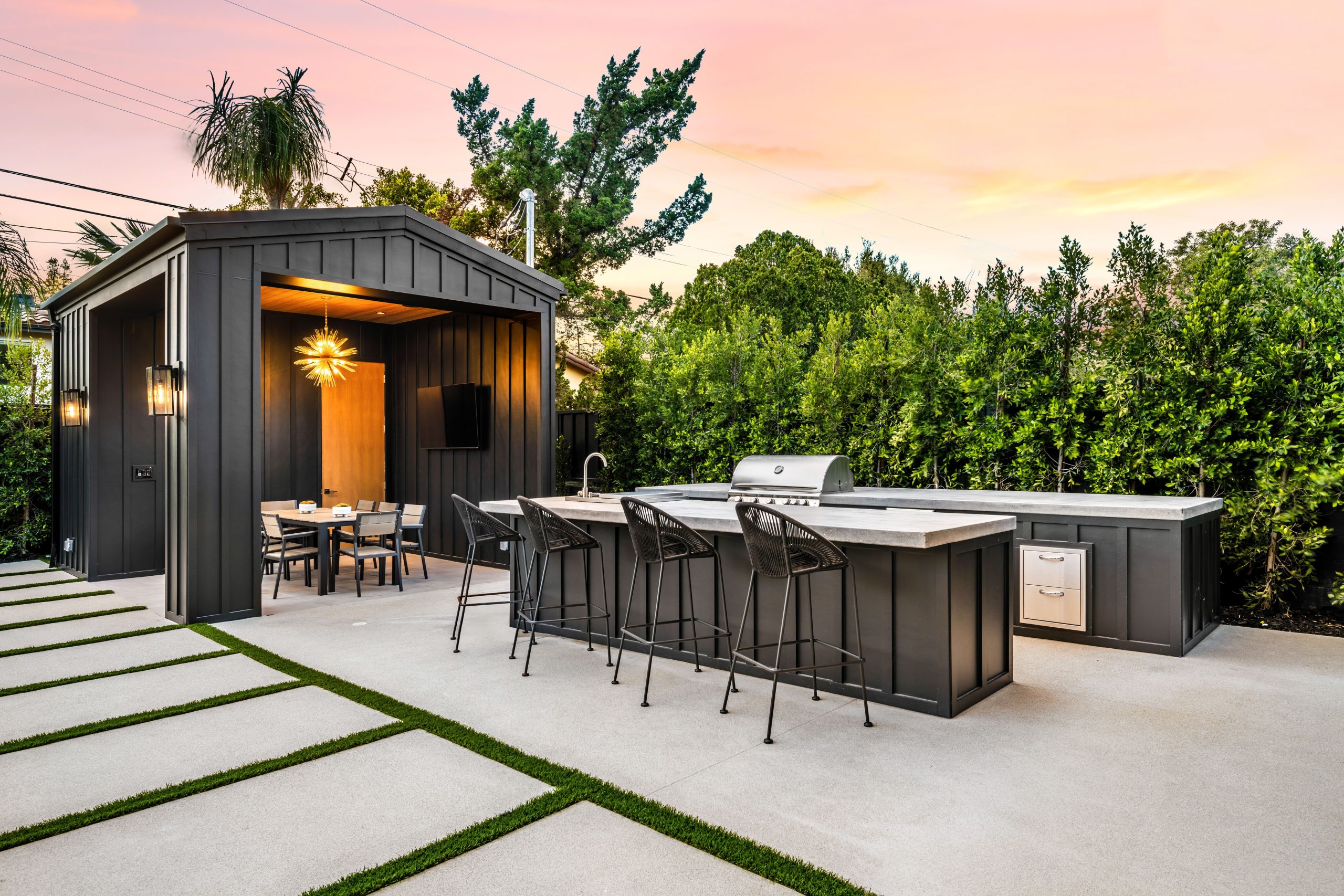
Outdoor kitchen benchtops in Australia have one job the indoor version never faces: surviving the same sun that can hit 45°C in Melbourne summer, alongside rain, humidity and, for coastal homes, salt air that eats through the wrong material in a season.
Get the material right and your outdoor kitchen looks the same in ten years as it did on day one. Get it wrong and you’re resealing, replacing or staring at a benchtop that’s faded, cracked or stained within a couple of summers.
We fabricate and install outdoor benchtops across Melbourne every week, through everything the climate throws at them. This guide breaks down which materials actually hold up, what they cost in 2026, and how to choose between them for your specific outdoor space.
Table of Contents
Why Australia’s Climate Decides Your Outdoor Benchtop Material
Australia has some of the highest UV levels in the world, and that single fact rules out more benchtop materials than any other factor. Four forces do the damage, and each one eliminates a different set of materials.
UV radiation
Sun exposure discolours, chalks or breaks down any material with resin in it. We pulled a badly yellowed engineered stone top off a Frankston alfresco last summer, three years old, never had a chance under that much direct sun. Porcelain, sintered stone, granite and quartzite don’t have that problem. No resin, no fade. Engineered stone and cheap laminates do.
Heat
A dark benchtop in direct Melbourne sun can hit 70°C in January. That’s hot enough to expand the material and, in anything weak, crack it. Granite, quartzite, porcelain and sintered stone shrug this off. Want it cooler underhand? Go lighter and matte. Dark and glossy always runs hotter.
Rain, humidity and moisture
Porous surfaces, think concrete, untreated natural stone, soak up water if they’re not sealed properly. Stains follow. Sometimes mould does too. Porcelain and sintered stone skip all of it, because there’s nothing porous for the water to get into in the first place.
Coastal salt air
Live near the bay? Salt settles on everything, and over years it’ll pit or etch a weaker stone. Dense natural stone and porcelain both cope well here. Just keep the natural stone sealed on schedule.
Quick definition: thermal shock
The rapid temperature swing that happens when a very hot pan meets a cold benchtop, or the other way round. It’s a real risk on any stone surface. Use a trivet, even on porcelain and granite.
What’s the best benchtop material for indoor-outdoor spaces?
Porcelain. If your kitchen runs from an indoor bench straight through to the alfresco zone, nothing else does the job as cleanly.
Here’s why. It’s the only material we install that performs exactly the same on both sides of the glass door: fully UV stable outside, non porous and low fuss inside, and it comes in a continuous slab so the same colour and pattern can run unbroken from your kitchen island out to the BBQ.
Granite can technically do it too. But its outdoor sealing schedule (every 12 to 18 months) doesn’t line up with the near zero maintenance most people expect indoors. You end up with one surface, two different care routines. That gets old fast.
Planning a genuine indoor-outdoor run? Talk to us before you order anything. Slab availability, thickness, and exactly where your surface crosses from covered to exposed all affect which porcelain range keeps its warranty outdoors, and that’s a lot easier to nail down against your actual floor plan than a spec sheet.
Best Outdoor Kitchen Benchtop Materials in Australia
Porcelain and Sintered Stone: The Modern Outdoor Standard
Porcelain and sintered stone (the compact, high pressure slabs marketed under names like Dekton and Neolith) have become the default choice for new Melbourne outdoor kitchens, and for good reason. Both are fired or pressed at extreme temperatures into a dense, non porous slab that’s fully UV stable, heat resistant enough for a hot pan straight off the grill, and needs no sealing at any point in its life.
The design range now covers convincing marble, granite, concrete and timber look finishes, so you’re not sacrificing style for performance. The one thing to get right is installation: edges can chip if fitted incorrectly, so this is a job for an experienced fabricator with the right equipment, not a general handyman.
For the full technical comparison between porcelain and engineered alternatives, see our porcelain vs Caesarstone guide.
Granite and quartzite: natural strength
Granite is one of the very few natural stones that actually thrives outdoors. Formed under real heat and pressure underground, it just handles Melbourne’s UV and temperature swings. No manufactured surface fully replicates that look, and people notice.
Quartzite does something similar, marble like veining with granite level toughness. A second natural stone option if you want that veined look without the maintenance headache marble brings.
Both need resealing every 2 to 3 years. Do that, and you’re looking at 15 to 25 years of outdoor life. Worth the wait.
Engineered stone: why it needs shade
Engineered stone, quartz, is popular indoors because of the resin binder. That resin makes it non porous, consistent, easy to work with.
Outdoors, that same resin turns into a problem. Sustained UV breaks it down over time: yellowing, cracking, fading, we’ve seen all three on jobs we didn’t do originally. Fine under a covered or semi shaded pergola. Not something we’d put in full Melbourne sun.
Marble: elegant, sheltered use only
Nothing else looks quite like marble. But it’s porous, and it etches the moment something acidic hits it, a splash of lemon juice at a barbecue is enough. That’s a real risk in a space built for entertaining.
| Material | UV Resistance | Heat Resistance | Maintenance | Lifespan | Best Use |
|---|---|---|---|---|---|
| Porcelain / Sintered Stone | Excellent, fully stable | Excellent, hot pans direct | Very low, no sealing | 25 to 30+ years | Full sun, coastal, indoor-outdoor runs |
| Granite | Very good | Strong | Reseal every 12 to 18 months | 15 to 25 years | BBQ zones, fully exposed kitchens |
| Quartzite | Very good | Strong | Reseal every 2 to 3 years | 15 to 25 years | Full sun, natural look |
| Concrete | Good | Excellent | Reseal annually | 10 to 20 years | Custom shapes, industrial style |
| Stainless Steel | Excellent, won't fade | Poor, gets very hot | None required | 20+ years | BBQ accents, not full sun benchtops |
| Tile (outdoor rated) | Good | Good | Frequent cleaning, grout care | 10 to 15 years | Covered or semi shaded zones |
| Engineered Stone | Poor in full sun | Moderate | Low, avoid direct UV | Shortened outdoors | Covered patios only |
| Marble | Low | Moderate | High, annual sealing | Shortened outdoors | Sheltered bars, decorative use |
Not sure which of these actually suits your space?
Outdoor Kitchen Benchtop Cost in Melbourne, 2026
| Material | Supply and install per m² | Typical 4 to 6m² outdoor kitchen |
|---|---|---|
| Tile (outdoor rated) | $150 to $400 | $900 to $2,000 |
| Concrete (custom poured) | $600 to $1,400 | $3,000 to $7,000 |
| Granite | $450 to $1,100 | $2,700 to $6,500 |
| Porcelain / Sintered Stone | $500 to $1,100 | $3,000 to $6,500 |
| Quartzite | $600 to $1,300 | $3,500 to $7,500 |
| Marble (sheltered use) | $650 to $1,300 | $3,800 to $7,500 |
Indicative 2026 Melbourne figures, ex GST. Outdoor installations typically cost more per square metre than the equivalent indoor material, since exposed edges, weatherproof fixing and additional structural support all add fabrication time.
Think about cost per year of use, not just the upfront number. Tile and concrete are cheaper to install but need more upkeep and may need attention sooner. Porcelain and granite cost more at the outset but are built to go the distance without repeat spending.
Design Tips for Outdoor Stone Benchtops
- Coordinate your benchtop finish with outdoor flooring or cabinetry for visual flow between zones.
- Choose matte or textured surfaces over high gloss to cut glare and hide fingerprints.
- Stick to neutral tones. They age more gracefully than trend colours in an open, sun exposed environment.
- Add functional details early: a drainage groove near the sink, or a raised heat ledge behind the BBQ.
- Run the same slab from island to back bench where possible for a joined, custom look.
Maintenance and Longevity Tips
- Clean with pH neutral cleaners and a soft cloth. Skip anything acidic or abrasive.
- Reseal granite, quartzite and concrete on schedule, don’t wait until staining shows.
- Cover benchtops during extreme weather or long stretches of non use.
- Rinse surfaces occasionally in coastal areas to clear salt deposits before they settle in.
- Use trivets on any material, including heat resistant porcelain and granite, to avoid thermal shock from very hot cookware.
Bring us your sun exposure,
your BBQ plan and your budget, and we’ll build the shortlist for you.
Which Outdoor Kitchen Benchtop Material Should You Choose?
Choose porcelain or sintered stone when:
- The benchtop sits in full, uninterrupted Melbourne sun.
- Your kitchen runs from indoors to outdoors as one continuous surface.
- You want the longest lifespan with the least ongoing care.
Choose granite or quartzite when:
- You want genuine natural stone character and don’t mind resealing every couple of years.
- The kitchen gets heavy daily use around a BBQ or pizza oven.
Choose concrete when:
- You need a custom shape, integrated sink, or a specific industrial look no slab can deliver.
Choose stainless steel when:
- You want a hardworking accent zone directly around the grill, paired with stone elsewhere.
Choose tile when:
- The area is partially covered and budget matters more than a seamless slab finish.
Outdoor Kitchen Benchtops: FAQs
What's the best benchtop material for indoor-outdoor spaces?
What is the best stone for an outdoor kitchen in Australia?
Is engineered stone suitable for outdoor use?
Can you put a hot pan directly on an outdoor benchtop?
How much does an outdoor kitchen benchtop cost in Melbourne in 2026?
Does salt air damage outdoor stone benchtops?
Ready to Build an Outdoor Kitchen That Lasts?
Melbourne’s sun, rain and salt air will find every weak point in the wrong material within a couple of summers. We’ve fabricated and installed outdoor benchtops across the city long enough to know exactly which ones don’t.
Tell us about your space and we’ll recommend the material, show you real slabs, and give you an itemised quote.
