
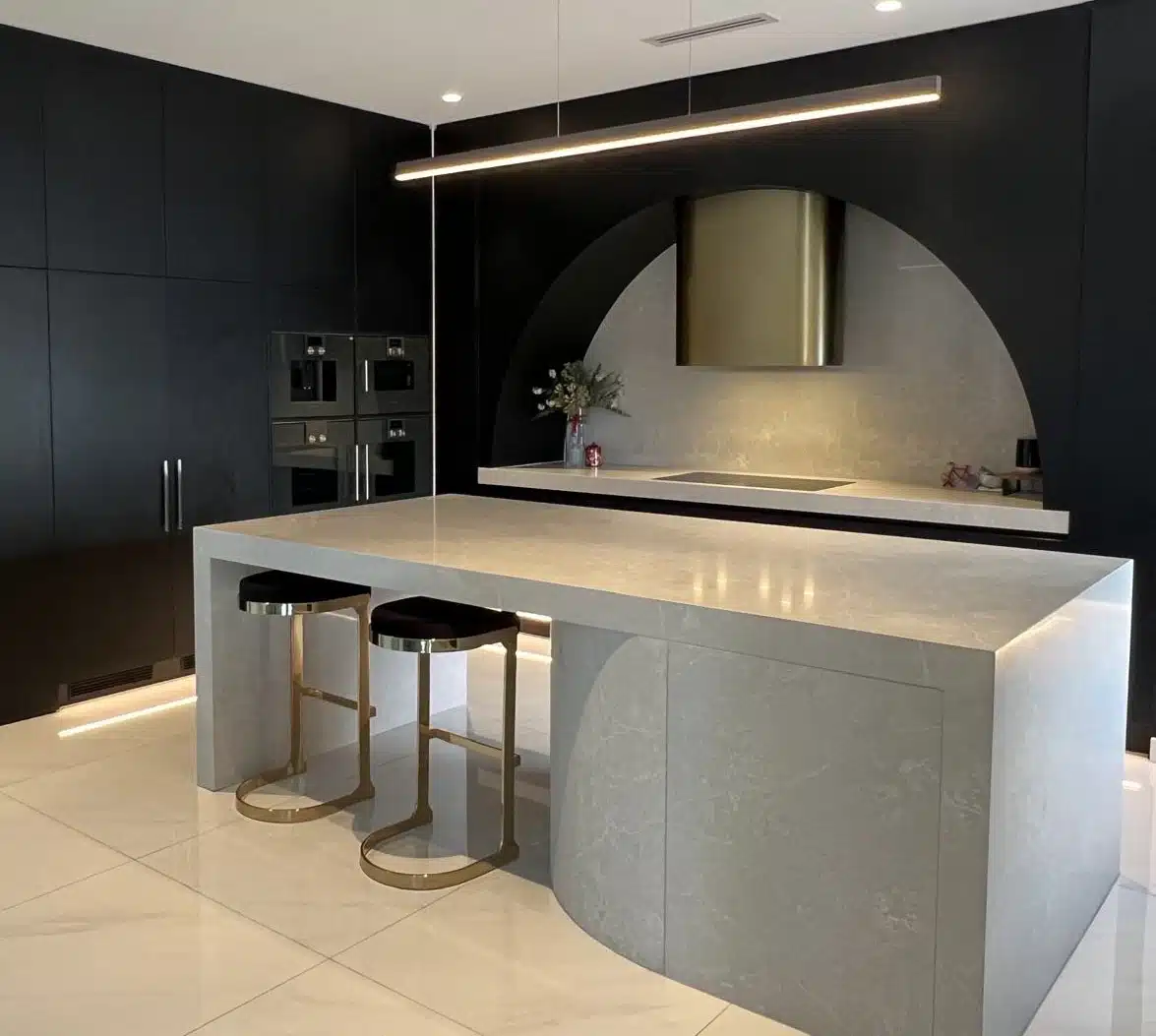
Let’s settle this debate right out of the gate. If you are planning a major kitchen renovation, you have probably scrolled through countless design feeds and wondered if a waterfall kitchen island is a smart investment or a fading fad. After decades of fabricating and installing custom stone across Melbourne, we hear this exact question in our showroom every single week. People want that undeniable luxury, but nobody wants to spend thousands on a feature that feels dated in five years.
2026 Design Verdict: No, waterfall kitchen islands are not going out of style.
However, the heavy, monolithic “block of stone” look is evolving. In 2026, the best designs favour mixed materials, partial waterfall drops, and highly considered detailing that adds warmth to the kitchen without losing that premium structural impact.
Here is exactly what you need to know about navigating modern waterfall island design, handling the true costs, and picking a style that actually lasts.
What is a Waterfall Kitchen Island Design? (And Why Do People Love Them?)
In a standard island, the stone stops at the horizontal edge, usually leaving a slight lip or overhang. A waterfall kitchen island design takes that same benchtop material and flows it vertically down one or both ends, dropping seamlessly right to the floor.
It creates a continuous, highly sculptural effect. We typically fabricate these using precise 45-degree mitred cuts so the veining cascades perfectly over the edge. It looks incredible, but it definitely changes how your kitchen functions.
Waterfall vs. Standard Kitchen Island: The Honest Pros, Cons, and True Costs
Before you commit to the extra slabs required for a waterfall edge, you need to weigh the daily realities. It is not just about looks.
The Advantages
Cabinet Protection: A solid stone end panel acts as armour. It protects your expensive custom joinery from scuffs, vacuum bumps, and the daily chaos of a busy family.
Safety and Seamlessness: Without protruding overhangs, there are fewer sharp corners for young kids to run into. It also perfectly conceals integrated appliances like under-bench wine fridges.
Visual Impact: It instantly elevates the room. A thick stone edge anchors an open-plan living space in a way standard cabinetry simply cannot match.
The Trade-Offs & Costs
The Price Tag: A waterfall end adds roughly $800 to $2,000 per end on top of your standard benchtop quote. Achieving a flawless, vein-matched mitred edge takes serious craftsmanship, and you often have to buy more stone than the bench alone needs just to match the pattern perfectly.
Structural Weight: A 40mm natural stone waterfall is incredibly heavy and usually requires reinforced cabinetry to hold the load. If you want to ease the structural strain, opting for 20mm porcelain is a smart alternative.
The “Crumb Factor”: Because there is no overlapping lip, anything you wipe off the counter falls straight down the vertical face and wedges into the seam where the stone meets the floor. You will likely rely on a hand-vacuum more often.
Lost Seating and Storage: A solid drop to the floor means you cannot tuck stools under the ends of the island. You also lose the option for open end-shelving.
Ready to stop guessing and start building?
How to Hide Outlets in a Waterfall Island (Without Ruining the Stone)
This is the number one logistical headache homeowners overlook. You cannot simply hack a hole into a premium stone slab as a casual afterthought. Electrical codes require accessible power, but slapping a standard white plastic wall plate onto your beautiful stone instantly kills the luxury vibe.
If you want outlets in a waterfall island, you have to plan it with your stone supplier and electrician before the first cut is ever made. Here is how we handle it in 2026:
Pop-Up Power Towers: These sit flush on the horizontal countertop. Press down, and a cylinder of outlets (and USB ports) rises up. When not in use, they practically disappear, leaving the vertical waterfall face completely untouched.
Under-Overhang Concealment: We can mount hidden outlet channels tucked tightly underneath the horizontal benchtop lip, completely out of sight on the working side of the island.
Colour-Matched Flush Mounts: If you absolutely must have the outlet on the vertical drop, we route a precise hole for flush-mounted, colour-matched faceplates (like Bocci outlets) that blend aggressively into the stone’s veining.
2026 Waterfall Kitchen Island Trends: What’s Actually Selling Right Now
Designers are currently moving away from stark, cold, ultra-minimalist spaces. The goal for a waterfall kitchen island 2026 update is all about adding warmth and texture.
| Trend | How It Works | The Vibe |
|---|---|---|
| The Partial Waterfall | The stone drops on one side facing the living area, while the other end is left open for seating or features timber joinery. | Balanced, highly practical, and cost-effective. |
| Mixed Materials | Combining a sleek quartzite or porcelain waterfall with a chunky, furniture-style antique timber breakfast bar attached to the side. | Earthy, lived-in, and full of character. |
| Fluted Stone Details | Instead of a flat vertical drop, the stone is carved or layered to create a ribbed, textured finish. | Architectural and deeply tactile. |
| Waterfall Peninsulas | Applying the waterfall drop to a kitchen peninsula (attached to a wall) to boldly separate the cooking zone from the dining area. | Excellent for zoning open-plan homes. |
The “Partial Waterfall” Island: 2026’s Smartest Kitchen Layout Strategy
Actually, the partial (or one-sided) waterfall is 2026’s smartest middle ground. You run the stone to the floor on one end only, leaving the other open for stools, shelving, or a warm timber panel.
You keep the sculptural statement on the sightline that matters for roughly half the premium. Our advice from hundreds of installs: position the stone waterfall face toward the main living room or entry sightline, and keep the working side open for seating and storage.
Porcelain, Granite, or Quartzite: Which Material Makes the Best Waterfall Benchtop?
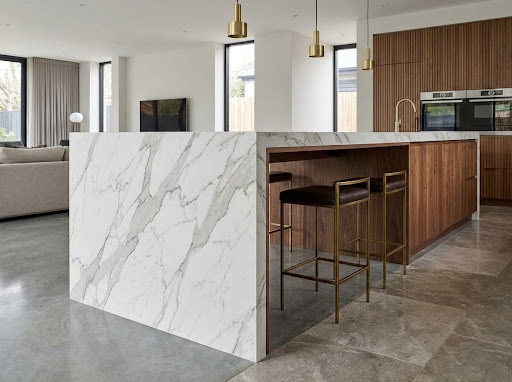
Not all stones are created equal when you are dragging them down to the floor. Because of the 2024 Australian engineered stone bans, the market completely shifted. Any engineered stone offered today must be a compliant sub-1% silica product (always ask for the manufacturer’s declaration first).
Porcelain is now the material we install most for waterfalls. It is totally non-porous, never needs sealing, and its lighter slabs cut real weight from the build.
Granite is the proven heat-resistant performer, easily handling a busy family kitchen.
Quartzite gives you the wild, dramatic veining of marble but boasts incredible hardness and resistance to scratching.
Curious about exact numbers for your renovation?
Explore Kitchen Benchtop Replacement Cost Guide now.
Waterfall Kitchen Island FAQs
Are waterfall kitchen islands out of style in 2026?
How much does a waterfall edge cost in Melbourne?
Should I choose a waterfall or a standard island?
Can you put power points on a waterfall island?
Do waterfall islands add value to a home?
Don’t just renovate—transform.
Elevate your home with a custom-engineered waterfall island that steals the show.


